Hospitality / AI-native SaaSin production
KaribuKit
An AI-native property management system for safari lodges, from reservation core to a guest-facing AI concierge.
250+Requests per second at peak
- Next.js
- Node.js
- TypeScript
Five people building websites, web apps, mobile apps, AI agents and a phone agent that speaks Gujarati. We build a working demo from your public pages before we ask for a rupee. If you want it, we make it real.
* sa·li·ent: the part that stands out. Also a bulge in a battle line. We mean the first one. Probably.
We are five people who got tired of telling businesses what was wrong with them. Thirty-four cold openers said it politely. Zero replied.
So we stopped writing and started building. Your own catalogue, your own photographs, your own phone numbers, on a link, before anyone asks for money. And clients who say,
What if the demo is live before the first call? What if it costs nothing to look? What if the price starts from this, made real?
Four live demos built in September from public pages and photographs. Five days total. Nobody asked, nobody paid, nothing touched their current site.
Our own QA, code review and docs run on an agent fleet at roughly $0.03 a run. We ship AI we live on first.
250+ requests per second, sub-second APIs, 99.9% uptime. Numbers from systems running today, not a pitch deck.
Eight disciplines, one accountable builder. Poke a row, watch the preview run.
We take AI features from roadmap to production: deciding which workflows deserve autonomy, prioritizing by cost, latency, and reliability, then building them. Grounding, evaluation, and human handover are part of the spec, not afterthoughts.
proof: Ranger, the KaribuKit guest concierge, answers from live reservation data and hands over to humans when it should.
Next.js portals, Node and NestJS APIs, Expo and React Native apps, structured in monorepos with clean seams. The kind of codebase a future team inherits gladly.
proof: KaribuKit spans staff portal, guest portal, API, and mobile app in one pnpm monorepo.
Agent fleets that review code, test products by driving real browsers, and run operations. Every agent we ship is caged: allow-list write guards, isolated worktrees, no self-merge, adversarially audited.
proof: Sentinel runs three agents 24/7 at roughly $0.03 per QA run, and caught production bugs no human test covered.
Project tracking, documentation, and cross-team workflows built as one coherent internal operating system, sized for the team that exists today.
proof: Hanuneeb's four departments coordinate through one internal OS the studio built.
Modular monoliths before microservices. Isolation enforced at the database layer. Idempotency as the default. Architecture decided with reasons written down.
proof: SignalOps enforces tenant isolation and billing limits where application bugs cannot route around them.
Specs, scoping, and build-versus-buy decisions from someone who has owned an AI product roadmap, not just implemented one. Business plans become dated engineering deliveries.
proof: As fractional CTO for Hanuneeb, the studio owns hiring, budget, and stack decisions end to end.
AWS, Docker, and CI/CD pipelines tuned for small teams that ship daily. Deployments measured in minutes, uptime measured in nines.
proof: KaribuKit's pipeline cut deployment time 30% while holding 99.9% uptime.
Messaging automations, background jobs, and scheduled agents that take real work off real people, with fallback routing for everything the machine should not decide.
proof: KaribuKit's booking automations measurably cut operational response times at live properties.
Each panel is a system running in the world, told the way it was built: problem, approach, architecture, outcome.
[ scroll to unlock. every number traces to a running system or a resume line. ]
An AI-native property management system for safari lodges, from reservation core to a guest-facing AI concierge.
A 24/7 autonomous agent fleet that reviews code, syncs docs, and QA-tests a live product by driving a real browser.
Ship reviewed, screenshot-verified pull requests from a phone. SSH over Tailscale in, one-tap merge out.
An event-driven multi-tenant backend that treats tenant isolation and idempotency as invariants, not features.
Technology ownership for an early-stage startup: architecture, delivery, and an internal operating system for four departments.
A 30-component enterprise library adopted across 15+ projects, cutting front-end effort by 40%.
A rebuilt booking site and a six-agent office copilot for a 35-year-old Gujarat bus operator, built on their real timetable before the first conversation.
The demo is built from your public pages before you pay. Then, if you want it, we make it real on your own domain.
book a 30-min call →Eight stages, fixed order. You see working software from week one and a written update every Friday. No mystery invoices.
We start with the business, not the backlog. What has to be true in six months for this to have worked?
we ask what customers keep calling to ask. that is the spec.
A shared definition of done
Users, constraints, prior art, and the honest question of whether AI belongs in this product at all.
we read your market. legally. mostly your competitors' sites.
Findings with recommendations
Boundaries, data flow, and invariants, decided before they get expensive. Reasons written down.
boundaries decided before they get expensive.
Architecture decision records
Interface and interaction design in code, where real constraints live. No throwaway mockups.
in code, where the constraints live. no throwaway mockups.
Working prototypes
Short cycles, visible progress, working software from week one. You watch it grow, not wait for it.
working software in week one. you watch it grow.
Shippable increments, weekly
Automated coverage on critical logic, plus agentic QA that drives the real product in a real browser.
an agent breaks it in a real browser so your users cannot.
Structured QA reports
Deployment pipelines, monitoring, and rollback paths rehearsed before the day they matter.
one green button. rollback rehearsed. nobody panics.
A production system, observed
Post-launch iteration driven by usage, performance budgets held, and a roadmap that stays honest.
our favourite chart. refreshes daily.
An ongoing partnership
sub-second apis. karibukit, peak booking hours.
the other 0.1% had a changelog.
september 2026. built from their own published pages. nothing touched their current sites.
sentinel. three agents. 24/7. caught bugs no human test covered.
One writes the code. The other four scope it, test it, load your data, wire your channels and keep it running after handover. The person on the call is the person who ships it.
founder · engineeringarchitecture, every line of code, scope and price, the call
The person on the call is the person who ships it. Says "yeah, that's possible", then writes the scope by the next morning.
delivery · operationsthe proposal, the project sheet, the friday update
Turns a call into a two-page proposal with two options and dated milestones inside 48 hours. Then keeps the dates true.
the brief, the test run, the acceptance list
Writes the one-paragraph brief before anything is built, then breaks the finished thing on purpose so your users cannot.
your real data in, live in accounts you own
Loads the catalogue, the timetable, the list, whatever the system runs on. Deploys to your accounts. Our access removable in one step.
whatsapp, phone, payments wired in, then watched
Wires the channels your customers actually use, tests each with a real message, and runs the care plan after handover.
[ every scene is a thing that happens on a real build. hover or tap a card to run it again. ]
We let shipped products speak first. Client words will live here as current engagements conclude; references are available on request.
daily users on platforms we engineered
[ verified ] QED42 production platforms, 2022 to 2024
uptime on systems we run today
[ verified ] KaribuKit production infrastructure
autonomous QA on everything we ship
[ verified ] Sentinel agent fleet
[ references available on request. client words land here as engagements conclude. ]
pairmark. One command. Two isolated worktrees. Your checks in both. Blind cross-judging. A verdict you can post.
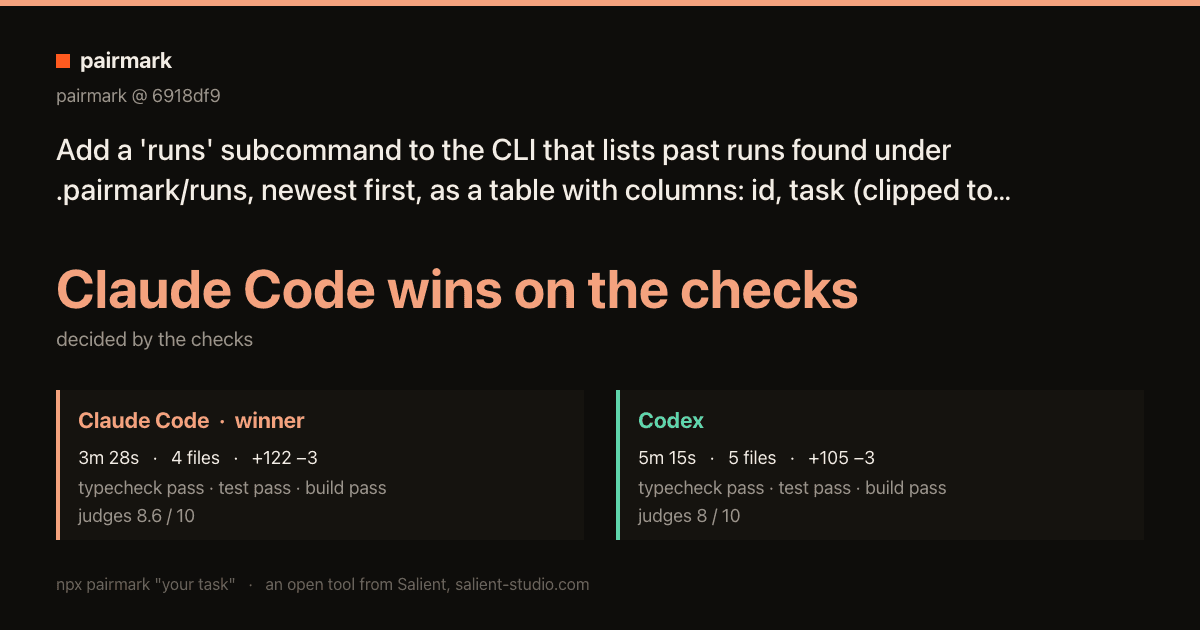
The first race on its own repository. Both patches passed every check. Codex also fixed a build-script bug, which touched package.json, so the checks rule went to Claude Code and Codex's dissent was recorded.
npx pairmark "add rate limiting to POST /api/login"Every AI native argues about which coding agent is better. Nobody has evidence from their own codebase. pairmark runs both agents on the same task in your repo, runs your tests in each result, has each agent judge both patches blind, and gives you one report with the rule that decided it.
Designed in a two-round discussion between Claude Code and Codex, built by Claude Code, and raced on itself. No API keys. It runs on the subscriptions you already have. MIT.
An always-on agent that watches PS5 prices on the PlayStation Store and Amazon, keeps its own price history, and posts only the drops that clear a hard bar, each with a cached verdict on whether the game is any good. Zero dependencies, any store region, one SQLite file. Designed by Claude Code and Codex, built in a day.
TypeScript end to end. Boring where boring wins, ambitious where it pays.
10 / start here
Bring the ambitious idea, the stalled build, or the AI roadmap that needs an owner. Thirty minutes. Not a sales pitch. We have 34 receipts proving we are bad at those.
About your product and constraints. Not a sales pitch.
Scope, dates, and price. Decisions argued with reasons.
If we are a fit, the build starts against commitments, not estimates.
Hemanshu architects and writes the code, augmented by an autonomous agent fleet for QA, code review, and documentation. The other four are on every build: Ujjval owns the proposal, milestones and the Friday update; Siddhant writes the brief and runs the test and acceptance pass; Rudra loads your data and deploys to accounts you own; Jaimin wires WhatsApp, phone and payments and runs the care plan. Nobody resells your project to subcontractors, and nothing is promised that the builder has not scoped.
By evidence. The systems in the work index run in production today: 250+ requests per second, 99.9% uptime, platforms serving tens of thousands of daily users. And by the demo: for local businesses we build a working concept from your public pages before you pay, so you judge the work, not the pitch. One active paid build at a time, on purpose.
Locally: a demo-first website (2 to 3 weeks), a site with a working booking or enquiry system (4 to 8 weeks), a mobile app, an automation inside one workflow, or a phone agent in English, Hindi and Gujarati. Internationally: a five-day build, an AI opportunity audit, a 4 to 6 week AI product sprint, or fractional AI product engineering. Every one starts with a call and a two-page proposal with two options, dated milestones, and a price. Deposit before any code is written.
Two ways. We build AI features into your product where they genuinely earn their place. And we use our own agent infrastructure (autonomous QA, code review, docs-sync) to hold quality on every project. AI accelerates the work; a human owns every decision that ships.
You do. Full ownership transfers on payment, repositories live in your organization from day one where possible, and there is no lock-in by design.
Launch is the midpoint, not the end. Monitoring, iteration cycles, and performance budgets continue as long as the partnership does. Several current engagements are ongoing by design.
Yes. Common shapes: owning the AI layer of your roadmap, architecting a system your team then builds, or fractional CTO work covering hiring, budgets, and build-vs-buy decisions.
TypeScript end to end. Next.js and React Native on the front, Node or NestJS with PostgreSQL, Redis, and BullMQ behind, AWS underneath. Boring where boring wins, ambitious where it pays.
4 questions. no spam. promise.
No twelve-field form. No calendar ambush. You type, the five of us read it, and the person who will build it replies with actual next steps.